The Real ROI of Digital Signage
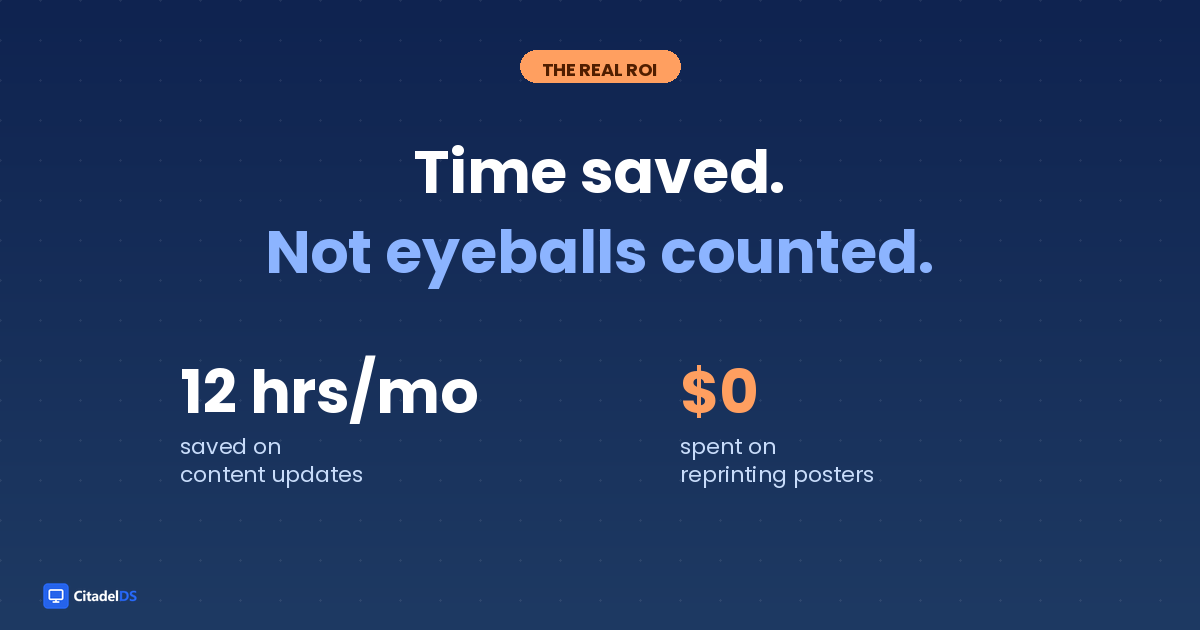
Why "time saved" beats "eyeballs counted" — and how to actually defend the spend.
When digital signage vendors pitch ROI, they usually lead with impressions. Your screen is seen by X patients per week. That's an impression count of Y. Therefore the ROI is...
Skip that math. It's the math that lets vendors quote you $400/month, and it's the math that gets shot down by every CFO who's ever seen a real ad-spend ROI calculation.
The actual ROI — the one that survives a finance review — is time saved by the team that no longer has to do the work the screen now does for them.
The calculation that survives a finance review
Run this mental model on your own practice:
Without a managed signage system, your team does these things by hand, every month:
- Designs and prints a new lobby flyer for whatever's seasonal (~2 hours)
- Updates the printed price list when something changes (~1 hour)
- Reposts a sign about the new staff member or new service (~30 minutes)
- Replaces the laminated "we accept these insurance plans" sign (~30 minutes)
- Hangs and re-hangs and re-laminates as things peel off (~1 hour total per month)
Total: roughly 5 hours per month of clinical or admin staff time, on a job that has nothing to do with what they were hired for.
At a fully-loaded staff cost of $30/hr (admin), that's $150/month of labor on lobby content. Annualized: $1,800/year per location.
Plus the cost of the printing itself — $20-80 per reprint, easily $400-800/yr at a single-location practice.
That's $2,200-2,600 a year of direct cost being absorbed without anyone calling it a line item. Citadel's per-screen cost runs $204/year ($17/mo). The math isn't even close.
What "eyeballs ROI" misses
Impression-based ROI assumes the value is in being seen. But:
- Patients in your lobby are already converted. They booked the appointment. They drove there. They're sitting in your chair. The marketing job is done for them.
- The real value of a lobby screen is operational, not marketing. It does the front desk's "what's new this month" job before the patient asks.
- Signage doesn't acquire patients. It retains and expands them. The screen tells your existing patient about the screening they didn't know you offered.
Counting impressions is what you do when you don't have a better number. Don't lead with it.
The other quiet line item: posters that go stale
There's a second ROI lever nobody puts on the spreadsheet: the cost of stale content.
A printed poster from Q1 that's still hanging in Q3 isn't free. It's actively negative. It signals that the practice doesn't keep up with itself. Patients notice the "Get Your Flu Shot" poster from last October still hanging in March. They don't say anything. They just lose a tiny amount of trust.
A managed screen never goes stale because the dashboard force-replaces last month's content. The "stale poster discount" your reputation pays is invisible until it isn't — usually on a Yelp review that says "the place felt outdated."
The honest case for impressions
There is a legitimate impressions argument, but it's narrow: measuring conversion lift on a specific lobby promo.
If you ran a "Free Screening Friday" promo and measured the bookings that came in tagged with "saw it in the lobby," you have a direct response number. That's the only impressions data point worth tracking. Everything else is hand-waving.
What this means for your team
If you're trying to get signage approved by someone who controls budget, don't pitch impressions. Pitch the 5 hours per month your front desk gets back, plus the $400-800 in printing you stop spending. Both numbers are defensible. Both numbers exceed the cost of the system within 3 months.
The eyeball ROI is real, but it's a bonus. The line item that gets it approved is the one your CFO can verify on the next P&L.
Want the numbers in your environment? Try Citadel free for 14 days at citadeldigitalsignage.com (https://citadeldigitalsignage.com). Track your actual content-update time before vs. after.
Ready to bring your screens to life?
Join thousands of businesses already using Citadel to engage customers, inform employees, and grow revenue — one screen at a time.