From Browser to Live in 5 Minutes
How modern digital signage actually works under the hood — and why the old-school stuff is still selling 6-week deployments.
----
If you've ever asked a vendor "how long until we're live?" and gotten an answer that involves the word quote, the words site survey, or anything ending in weeks, you're talking to the wrong vendor.
Modern digital signage looks more like deploying a Sonos speaker than installing an alarm system. Here's the actual flow under the hood.
The three pieces
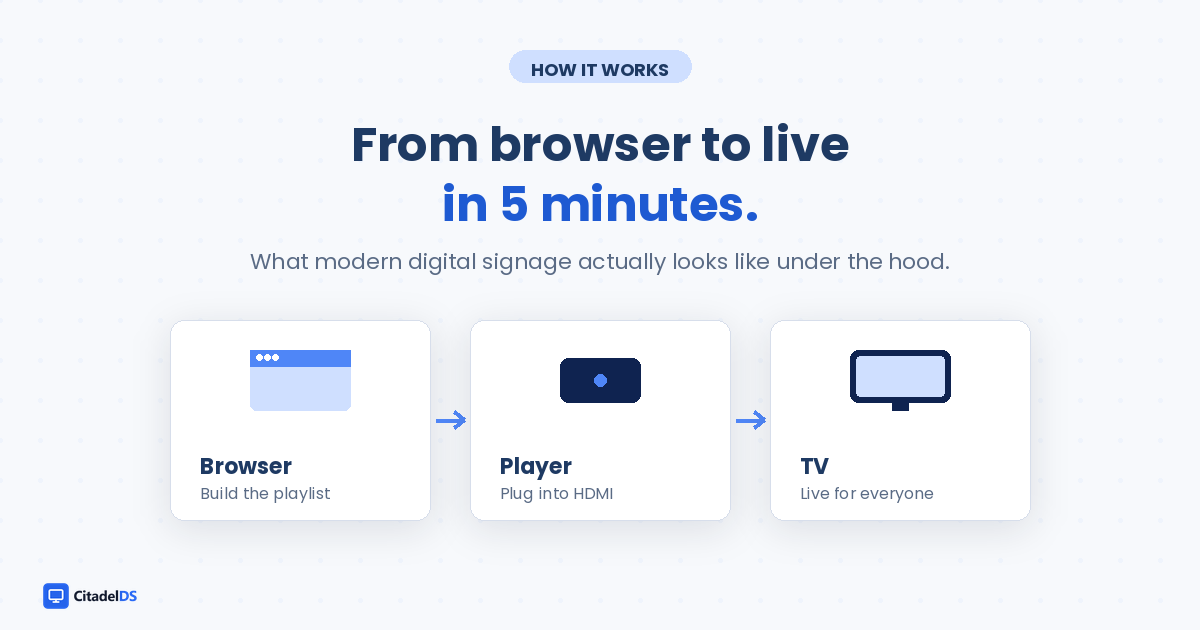
There are exactly three components in any browser-managed signage system:
1. A cloud dashboard you log into from any browser
2. A small Player device that connects your TV to the dashboard
3. The TV itself — yours, any HDMI input, any size
Everything else — the apps, the templates, the scheduling, the multi-screen management, the analytics — runs in the dashboard. The Player is the messenger between your dashboard and your screen.
That's it. There is no "head-end server." There is no "site controller." There is no IT closet full of blinking lights. If a vendor's architecture diagram has more than three boxes, ask why.
What happens in the 5 minutes
Here's the actual onboarding flow we've measured across thousands of installs:
Minute 0 — You receive the Player in the mail. It's about the size of a Roku stick.
Minute 1 — Plug the Player into the TV's HDMI port. Plug the power cable in.
Minute 2 — TV displays a 6-digit pairing code on screen.
Minute 3 — In your browser dashboard, paste the 6-digit code. The screen now shows up in your dashboard.
Minute 4 — Drag a starter template into the playlist for that screen.
Minute 5 — The TV is showing your branded content.
That's the whole flow. We've watched front desk staff who weren't told it was a "tech project" do this without help.
Why "old-school" deployments take 6 weeks
If your vendor is quoting weeks of work, ask what's actually happening during that time. The honest answer is usually one of three things:
They're shipping you a proprietary screen. That's a 4-week lead time on hardware. Avoid this — your existing TVs work fine.
They're scheduling a "site survey." This is the digital signage industry's equivalent of a pre-construction inspection. It's almost never necessary for a single-screen install. It exists because the vendor makes margin on installation labor.
They're "configuring your account." This is account setup that should take 90 seconds being stretched into a billable engagement.
The legitimate version of "we need a few weeks" is for enterprise rollouts of 50+ screens across many physical sites, where there are real logistics involved — shipping coordination, IT security review, mounting variation per site. For one screen in one lobby? It's 5 minutes.
What actually drives the dashboard
The dashboard is where you spend your time. The good ones look like a slightly-more-purpose-built version of Notion or Figma. The mental model is:
- Content — the individual things that play (a flyer, a video, a review, a weather widget)
- Playlists — ordered groups of content that play in a loop
- Schedules — rules that decide which playlist plays at which time of day
- Screens — your individual TVs, each assigned a schedule
A good signage tool lets a non-technical person change content, drag-and-drop the order, and have it reflect on the screen in seconds. A bad one feels like SharePoint.
What this means for your team
If you're evaluating signage vendors and one of them quotes you 4-6 weeks for a single screen, you're looking at the wrong vendor. The architecture for browser-managed signage settled years ago, and the bar for time-to-live is today, not next month.
The right test: ask the vendor to ship you the Player same-day, then time how long it takes you to get it live. If they push back on that test, that tells you exactly how long the install actually takes them.
Want to time it yourself? Try Citadel free for 14 days at citadeldigitalsignage.com (https://citadeldigitalsignage.com). Player ships in 1 business day.
Ready to bring your screens to life?
Join thousands of businesses already using Citadel to engage customers, inform employees, and grow revenue — one screen at a time.